
Free Evaluation: (800)290-1084

◉ Kratom Lawsuit Claims

They Called It Natural. It Acted Like an Opioid.

Verdicts, federal seizures, and actions by Attorneys General across the country have proven what grieving families have known all along: these companies knowingly sold a dangerous, opioid-like substance while marketing it as a safe, natural supplement. If you or a loved one suffered addiction, overdose, organ failure, or death after using kratom or 7-OH products, you may be owed significant compensation.

Free Case Evaluation

Complete this quick form, and a legal specialist will contact you within 24 hours.

By submitting, you agree to be contacted by phone, email, or SMS/text (data rates may apply), even if you are on a federal or state Do Not Call registry, to confirm your information and verify eligibility.

Legal Criteria

See If Your Family Qualifies

for Cash Compensation.

To qualify, you must have used a kratom or 7-OH product and experienced one of the following documented harms.

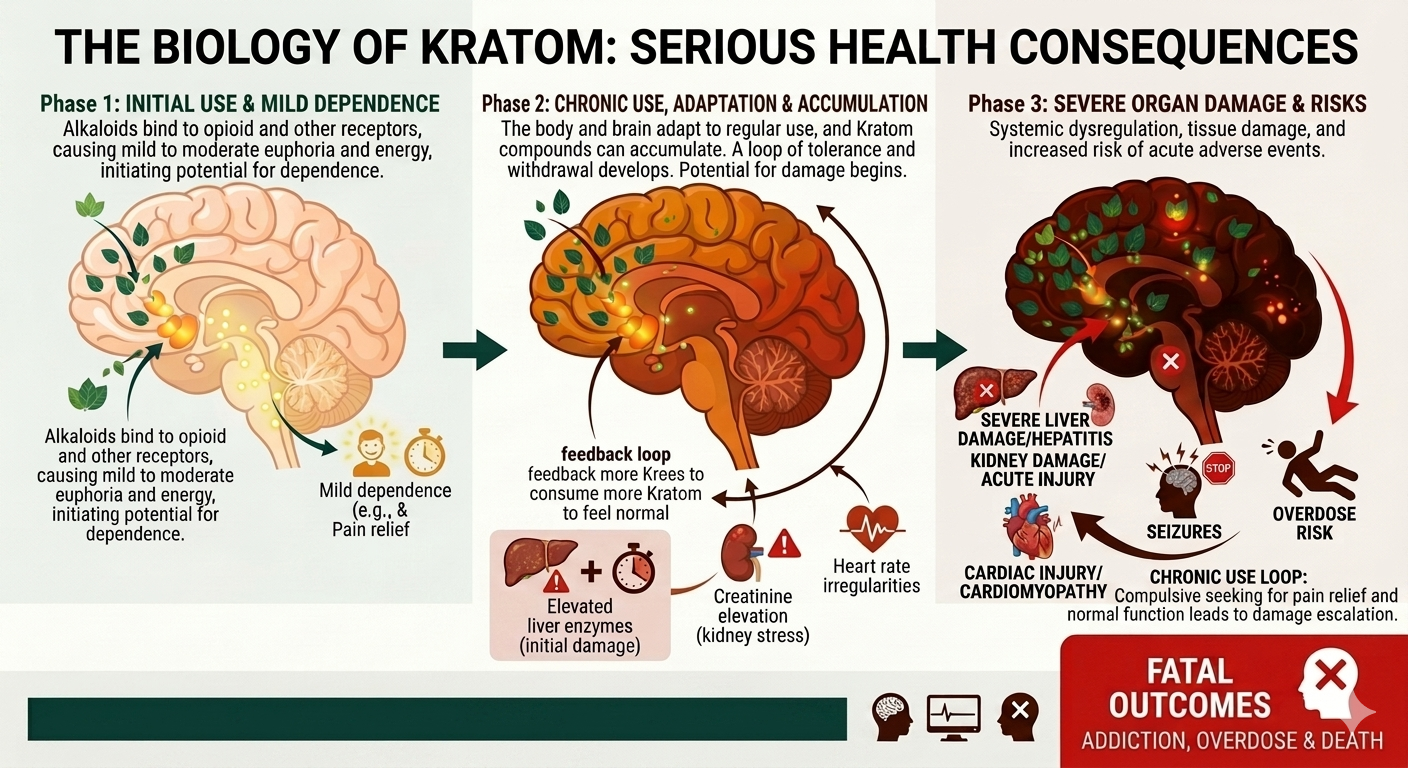
Cardiac / Heart Injury

Heart attack or cardiac arrest linked to kratom or 7-OH use, including ventricular arrhythmias. Medical research has linked kratom alkaloids directly to dangerous cardiac events, even in otherwise healthy individuals.

Liver or Kidney Damage

Organ damage, including liver toxicity, kidney failure, or related conditions, following kratom or 7-OH use. These injuries often require ongoing medical treatment and may result in permanent impairment.

Addiction / Dependency

Chemical dependency on kratom or 7-OH, including withdrawal symptoms such as severe aches, cold sweats, agitation, and inability to stop use. 7-OH functions like an opioid in the body and carries a high potential for addiction.

Overdose

Non-fatal or fatal overdoses from kratom or 7-OH products, including respiratory depression and loss of consciousness. Products have been found to contain compounds up to 96% 7-OH, nearly 50 times the legal limit in states that regulate it.

Seizures

Seizure activity following Kratom or 7-OH use, including single or recurring episodes. Neurological harm is among the documented adverse effects reported to the FDA and state health agencies.

Respiratory Distress

Difficulty breathing, respiratory depression, or related complications tied to kratom or 7-OH use. The FDA has confirmed that 7-OH produces respiratory depression at more than three times the potency of morphine.

Legal Criteria

It’s Not Your Fault.
It Was in the Product.

These products weren’t sold as drugs; they were sold as herbal supplements, wellness shots, and natural remedies, displayed next to energy drinks at gas stations and smoke shops. But behind the branding, manufacturers were distributing a substance that acts like a powerful opioid, with no dosage guidance, no safety testing, and no warning of the risks.

The Deception

Marketed as Natural, Designed to Addict

Kratom and 7-OH products were deliberately packaged and marketed to appeal to people seeking pain relief, energy, or a way off traditional opioids the exact populations most vulnerable to addiction. Companies claimed their products were safe and natural while concealing that some contained 7-OH levels nearly 50 times the legal limit.

The Harm

An Unregulated Opioid at Every Corner

The FDA has raised particular concern about the growing availability of concentrated 7-OH products appealing to children and teenagers, such as fruit-flavored gummies, candies, and ice cream cones. The FDA reports that 7-OH produces respiratory depression with more than three times the potency of morphine. These products were openly available without age verification, prescription, or safety oversight.

The Result

Families Paying the Price

The CDC published data showing that annual hospitalizations from kratom exposure increased by 1,200 percent from 2015 to 2025. Attorneys General in Texas, Missouri, and other states have now taken legal action, and private families are doing the same.

Up 1,200%

The CDC published data showing that annual hospitalizations from kratom exposure increased by 1,200 percent from 2015 to 2025.
Government Actions & Court Rulings

$2.5M & Counting

Multiple States. Federal Agencies. All Saying the Same Thing.

Texas AG Sues Pure Leaf Kratom & Outcast Distribution

Laboratory testing confirmed that multiple products sold and shipped into Texas by Pure Leaf Kratom LLC and Outcast Distribution LLC contained 7-OH levels ranging from 86% to 96% of total alkaloid content, far exceeding the 2% maximum allowed under Texas law.

$2.5 Million Civil Jury Verdict – First of Its Kind in the U.S.

A Cowlitz County jury issued a verdict of $2,500,000 in the first civil wrongful death jury verdict against a kratom manufacturer in U.S. history, finding the defendant liable under the Washington Consumer Protection Act.

Texas AG Sues Smokey’s Paradise

Texas Attorney General Ken Paxton sued kratom retailers operating as Smokey’s Paradise for deceptively marketing and selling products containing up to 96% 7-OH, nearly 50 times the legal limit under the Texas Kratom Consumer Health and Safety Protection Act. The lawsuit seeks to end the sale of illegal kratom products and to seek civil penalties under the Texas Deceptive Trade Practices Act.

Missouri AG Sues EDP Kratom / RRR – Suspension of All Sales

Missouri’s AG filed suit against Relax Relief Rejuvenate Trading LLC (EDP Kratom) for the manufacture and sale of kratom alkaloids, including 7-OH and the synthetic compound MGM-15, alleging failure to disclose dangerous active ingredients, downplaying addiction risk, and falsely claiming it was impossible to overdose on 7-OH. RRR subsequently agreed to suspend all in-state sales of 7-OH and kratom alkaloids immediately as part of a settlement resolution.

DEA Notice of Intent to Schedule 7-OH – Schedule I

HHS and the FDA commended the DEA’s issuance of two Notices of Intent to begin the temporary scheduling process for 7-OH and three synthetic 7-OH derivatives, MP, MGM-15, and MGM-16, placing them into Schedule I of the Controlled Substances Act. This followed a comprehensive scientific and medical review in which HHS and FDA recommended scheduling in 2025.

Missouri AG Sues CBD American Shaman

Missouri Attorney General Catherine Hanaway filed suit against CBD American Shaman and a web of connected companies for the manufacture, distribution, and retail sale of kratom and 7-OH, alleging they marketed these drugs without required safety testing and regulatory approvals, and dangerously misled consumers, including those struggling with opioid addiction, into believing 7-OH was safe and natural.

ATTORNEY ADVERTISEMENT

This website or its third-party tools use cookies, which are necessary for its functioning and required to achieve the purposes illustrated in the cookie policy, including the personalization and analysis of ads and content. If you want to learn more please refer to the cookie policy and privacy policy. You accept the use of cookies by scrolling this page, by clicking a link or button or by continuing to browse otherwise.

41877 Enterprise Cir N # 200, Temecula, CA 92590