
Free Evaluation: (800)397-2670

◉ Bard Powerport Claims

Did Your Bard PowerPort Device Fail You?

Thousands of patients trusted their Bard PowerPort to safely deliver chemotherapy and other infusion treatments only to suffer serious, life-altering complications when the device cracked, migrated, or caused dangerous infections. Lawsuits allege the company failed to fully communicate known risks, and the litigation is growing fast. As of October 2025, nearly 2,000 active cases were pending in the federal MDL, with more than 1,000 new cases joining in 2025 alone. If your PowerPort was implanted after 2007 and caused you serious harm, you may be owed significant compensation.

Free Case Evaluation

Complete this quick form, and a legal specialist will contact you within 24 hours.

By submitting, you agree to be contacted by phone, email, or SMS/text (data rates may apply), even if you are on a federal or state Do Not Call registry, to confirm your information and verify eligibility.

Legal Criteria

See If Your Family Qualifies

for Cash Compensation.

To be considered for this lawsuit, you must meet the following criteria. Start by confirming the basics:

Bard PowerPort Implanted After 2007

The device must be a Bard brand PowerPort (not another manufacturer) and must have been implanted in 2007 or later for infusion treatment, not dialysis.

Device Failure Occurred

The port must have malfunctioned or caused harm. Qualifying failures include catheter breakage, fracture, and migration, in which the device did not perform as intended.

Port Has Been Removed

The PowerPort must have been removed as a result of the complication to be considered eligible.

Injury Timing

The qualifying complication must have occurred at least 30 days after the initial implant date.

Qualifying Injury Within the Last 5 Years

Your injury must have occurred within the last five years. Recognized injuries include:

  • Catheter Breakage or Fracture – device cracked or split inside the body
  • Migration – the port or catheter moved from its original placement
  • Infection – must have resulted in hospitalization
  • Perforation – device punctured surrounding tissue or organs
  • Organ Failure – directly related to device failure
  • Implant Complication Resulting in Death

Legal Criteria

The Device Was Supposed

to Be Safe. It Wasn’t.

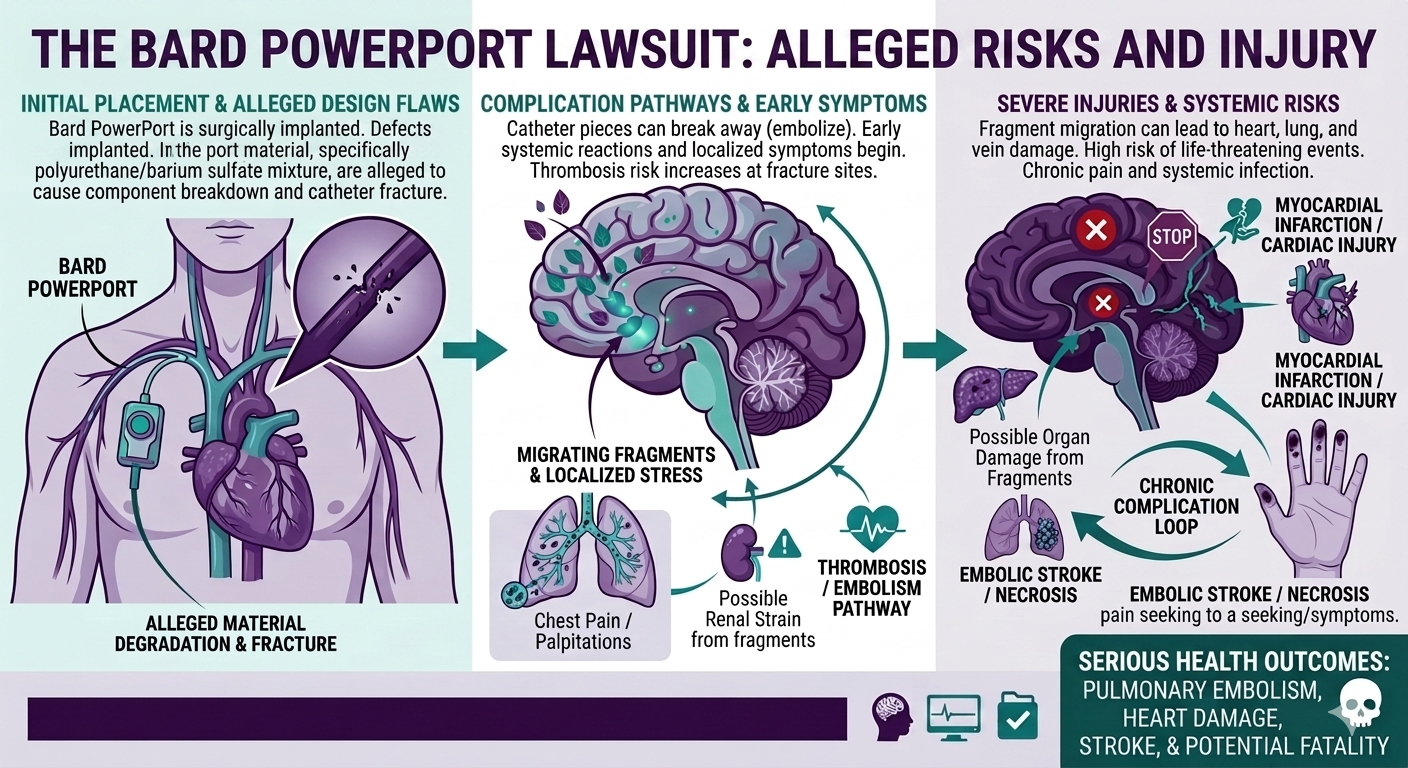
The Bard PowerPort uses a catheter material called Chronoflex, and lawsuits allege this material is prone to cracking and fracturing inside patients’ bodies. When that happens, fragments can migrate through the bloodstream, cause life-threatening infections, or puncture surrounding tissue and organs. These weren’t unknown risks. Plaintiffs allege Bard and its parent company, Becton Dickinson, had reason to know about these failure modes and failed to adequately warn patients or physicians.

The Device

Chronoflex Catheter Material

Designed for long-term vascular access, the Chronoflex catheter used in Bard PowerPorts has been alleged to be structurally prone to cracking and fracturing, a defect that can cause catastrophic internal complications.

The Failure

Breakage, Migration, Infection

When the catheter fractures, pieces can travel through the vascular system. Migration can lodge in the heart or lungs. Infections from device failure have sent patients back to the hospital, some repeatedly.

The Result

Patients Left Without Answers

Reports show complications with PowerPort devices can go unreported for years, only coming to light when patients pursue legal action. Many patients had no idea the device itself was responsible for their suffering.

3,300

Active federal lawsuits as of late 2025 and growing.
Active

Over 3,300 Active cases

Where the Case Stands Now

MDL 3081 – Active Federal Litigation

All Bard PowerPort cases were centralized before Judge David G. Campbell in the U.S. District Court for the District of Arizona under MDL No. 3081. The first bellwether trial was scheduled for early 2026, with five additional trials set through the end of the year. Bellwether outcomes will shape settlement negotiations for the thousands of remaining claimants.

Cook v. Becton, Dickinson – First Bellwether Trial

The first bellwether resulted in a mixed outcome; the jury found in favor of Bard on failure-to-warn claims but was unable to reach a unanimous verdict on design defect. The plaintiff subsequently filed a motion for a new trial, arguing that jury instructions were improper and contributed to the result.

What Comes Next

No global settlement has been announced. Settlement negotiations typically follow bellwether verdicts, and the litigation remains active with additional trials scheduled. Bard’s parent company, Becton Dickinson, has a history of settling in similar device litigation; the company resolved approximately 38,000 hernia mesh lawsuits for an estimated $1.7 billion in 2024 after losing several bellwether trials in that MDL.

ATTORNEY ADVERTISEMENT

This website or its third-party tools use cookies, which are necessary for its functioning and required to achieve the purposes illustrated in the cookie policy, including the personalization and analysis of ads and content. If you want to learn more please refer to the cookie policy and privacy policy. You accept the use of cookies by scrolling this page, by clicking a link or button or by continuing to browse otherwise.

41877 Enterprise Cir N # 200, Temecula, CA 92590